
Everything in its Right Place, at the Right Time
Radiohead's Kid A Mnesia story is a 25-year master class in what happens when artists treat their work as a living archive rather than a finished product.

Going to the Industrial Complex for Art
Imagine an idyllic pre-summer day in May in New York City. This is the period between the annual wrap-up of traditional performing arts seasons and the beginning of the summer offerings. You’re fortunate to spend some time and explore the city that never sleeps - and also has countless offerings. I was privileged to have this opportunity a few weeks ago.
I chose to have a lunchtime excursion to the Brooklyn Navy Yard Building No. 269, the home of Agger Fish Corp., which serves as an importer, exporter, and processor of marine products. When it’s not full of fish, sometimes the building is used for other events, including US Presidential election debates


Industrial. Blacked-out windows. A bunker of some sort. The structure lends itself to become what the producer wants it to be. As I walk in, music fills the space, not as background, but as the architecture of a greater presentation. The songs are twenty-five years old. The experience feels like it was made this morning.
This is Motion Picture House: Kid A Mnesia, the latest iteration of a creative universe that began when Radiohead locked themselves in a studio in 1999, decided to abandon everything that had made them famous, and made two of the most important albums of the century. Delivered by 12 large trucks, the immersive exhibition draws from the eerie aesthetic of the Radiohead albums Kid A (2000) and Amnesiac (2001), as well as art created by frontman Thom Yorke and Stanley Donwood. The experience culminates with a 75-minute film. This experience, which started in earnest at Coachella in a bunker, will travel from Brooklyn to Chicago, Mexico City, and San Francisco. I say “in earnest” because this iteration was delayed by a global pandemic. Six years later, it’s not become a fully realized event - not in an art gallery, but in a space removed from the art industrial complex to another industrial complex. Someone negotiated those rights. Someone is producing those transfers. The work didn’t just survive twenty-five years — it was, whether by accident or design, structured to continue.
That distinction — between work that survives and work that is structured to continue — is the question I want to sit with here. Because performing arts organizations talk endlessly about legacy, relevance, and longevity, and very few of them build the creative infrastructure or negotiate the agreements that would make any of those things actually possible.
A Twenty-Five Year Timeline That Wasn’t a Plan
Ok, we need to start at the beginning, because the timeline matters.
Kid A - 2 October 2000
October 2000. Kid A is released with no singles, almost no press, no traditional promotional machinery at all. Radiohead toured Europe in a custom-built tent with no corporate sponsors. Instead of interviews, they released short animations. Instead of radio play, they used the internet — then barely a promotional tool for anyone — to reach audiences directly. The album was, by the logic of the music industry at the time, an act of commercial suicide.
It won the Grammy for Best Alternative Album. It was nominated for Album of the Year. Rolling Stone eventually ranked it the twentieth greatest album of all time.
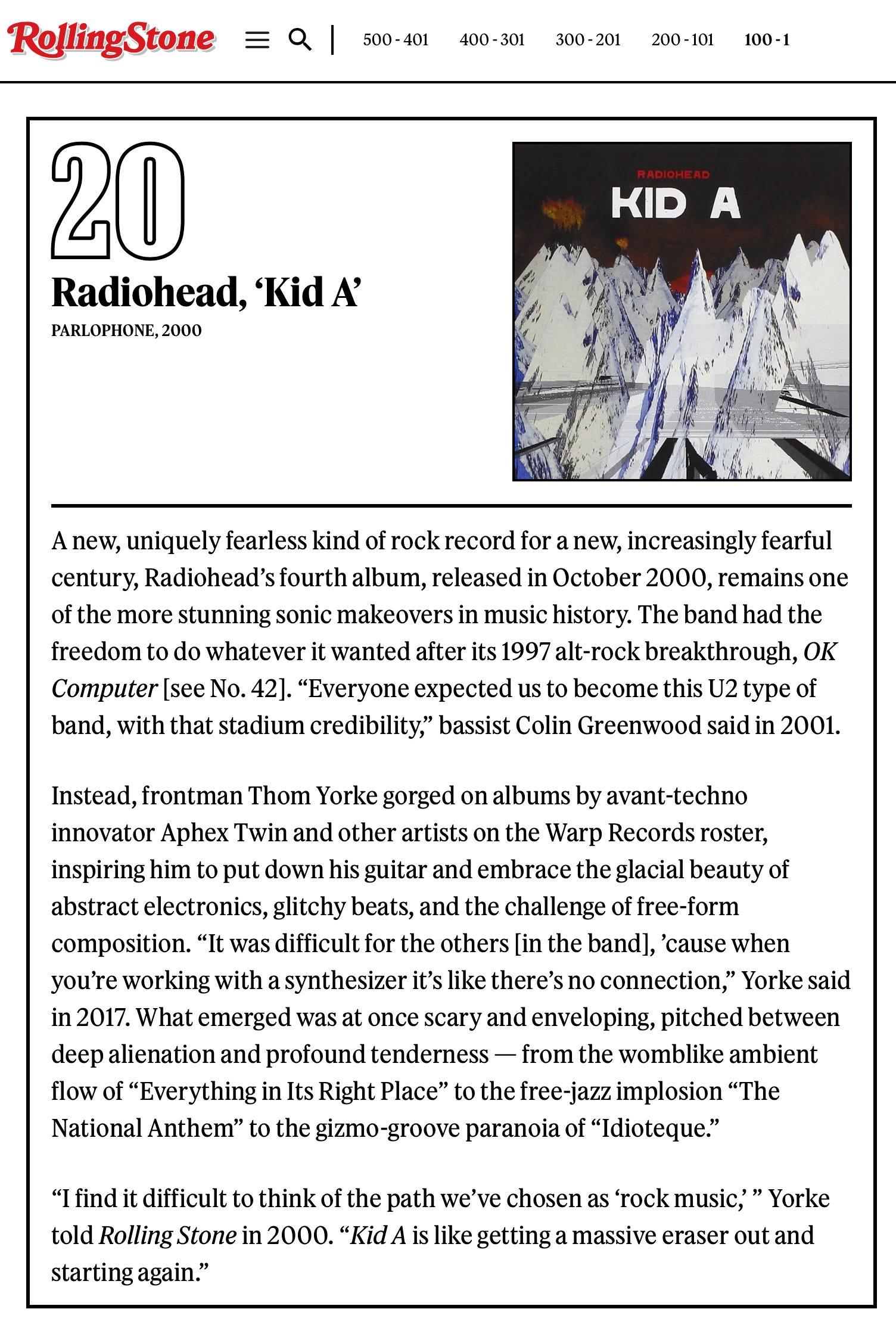
The tent was not a liability. The refusal of conventional infrastructure was not a risk. It was, in retrospect, the first signal that Radiohead was building something whose value would outlast the promotional cycle.
Amnesiac - 30 May 2001
Six months later, Amnesiac — recorded in the same sessions but held back because, as the band said, releasing it all felt like too much — arrived with singles, music videos, and a North American tour.
The sister album. The companion text.
Two distinct artifacts made from the same raw material, released into the world separately, finding separate audiences, occupying different critical spaces.
And then, for twenty years, the work existed. It was listened to, written about, studied, covered, sampled, argued over. The canonical rock critical establishment built much of its 2000s vocabulary around it. But the work itself was finished. Filed. Complete.
Except it wasn’t.
Divertisement 1: GooglyMinotaur, Chatbot before ChatGPT or: What Radiohead Knew About Audience Infrastructure in 2001
Before we get to the reissue and the exhibition at the fish building, I need to bring GooglyMinotaur into this story, because it is the most important data point in this entire story for arts administrators, and almost no one in the performing arts has ever heard of it.
In June 2001, simultaneous with the release of Amnesiac, Radiohead launched an instant messaging bot on AOL Instant Messenger. It was called GooglyMinotaur, named for the figure on the Amnesiac album cover — a minotaur in a red coat, painted by Thom Yorke and longtime collaborator Stanley Donwood. Developed by a company called ActiveBuddy under contract with Capitol Records, the bot provided tour information, band facts, MP3 downloads, and exclusive content. It also, in the language of the era, made idle conversation. You could talk to it. It talked back.
The record label, representing and facilitating the desires of the artist, hired a specialized company to partner with their artist, and another tech partner to be the platform.
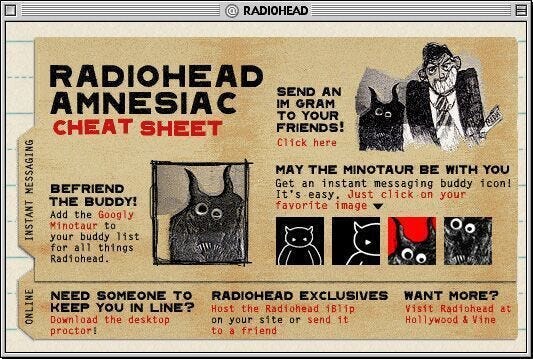
By November 2001 — five months after launch — GooglyMinotaur was on 387,000 buddy lists and had received more than 36 million messages. By the time it was switched off in March 2002, it had exchanged approximately 60 million messages with nearly one million different people.
Let that number sit for a moment.
One million individual audience touchpoints.
Zero singles on the radio.
In 2001.
Radiohead — or rather, Radiohead’s label and their digital partners — understood in 2001 that the album was not the product. The album was the entry point. The relationship with the audience was the product. The infrastructure to sustain that relationship was the investment.
The question of how to build genuine, scalable, iterative contact with an audience — contact that feels like conversation rather than broadcast — remains largely unsolved in this sector. Radiohead solved it accidentally, on AIM, twenty-five years ago, for an album with no singles.
DIVERTISEMENT 2: Stanley Donwood and What a Thirty-Year Collaboration Actually Looks Like
No account of this work is complete without naming Stanley Donwood, the professional name of Dan Rickwood, who has created every piece of Radiohead’s visual artwork for over thirty years, beginning with the My Iron Lung EP. He and Yorke were classmates at University of Exeter.
For Kid A, Yorke & Donwood abandoned digital manipulation entirely and used paint for the first time — large canvases worked with knives and sticks and a textured building compound, then photographed and edited in Photoshop. They were deep in the data on environmental collapse during this period; the mountain range that became the cover was, in Donwood’s words, “some sort of cataclysmic power.” For Amnesiac, he explored London as a labyrinth, scanning blank pages from old books and overlaying photographs of fireworks, Tokyo tower blocks, Piranesi’s Imaginary Prisons drawings, and lyrics Yorke printed on a broken typewriter.
None of this is branding. It is visual thinking developed in genuine parallel to the music. This is typical of a new opera production or album, of course. However, over the years, Yorke, Donwood, and Godrich were able to utailize their assets from previous iterations making new work from the same source material - a video game, a physical bunker, a spatial audio remix — as a living archive of creative intention.
That continuity is only possible when the creative relationships are treated as permanent infrastructure rather than project-specific engagements. Most performing arts organizations hire a set designer for a run. They almost certainly don’t negotiate the right to reuse that visual work twenty years later. Radiohead’s thirty-year collaboration with Donwood is the proof of what it looks like when they do.
When the Plan Fails, the Work Continues
Kid A Mnesia - 5 November 2021
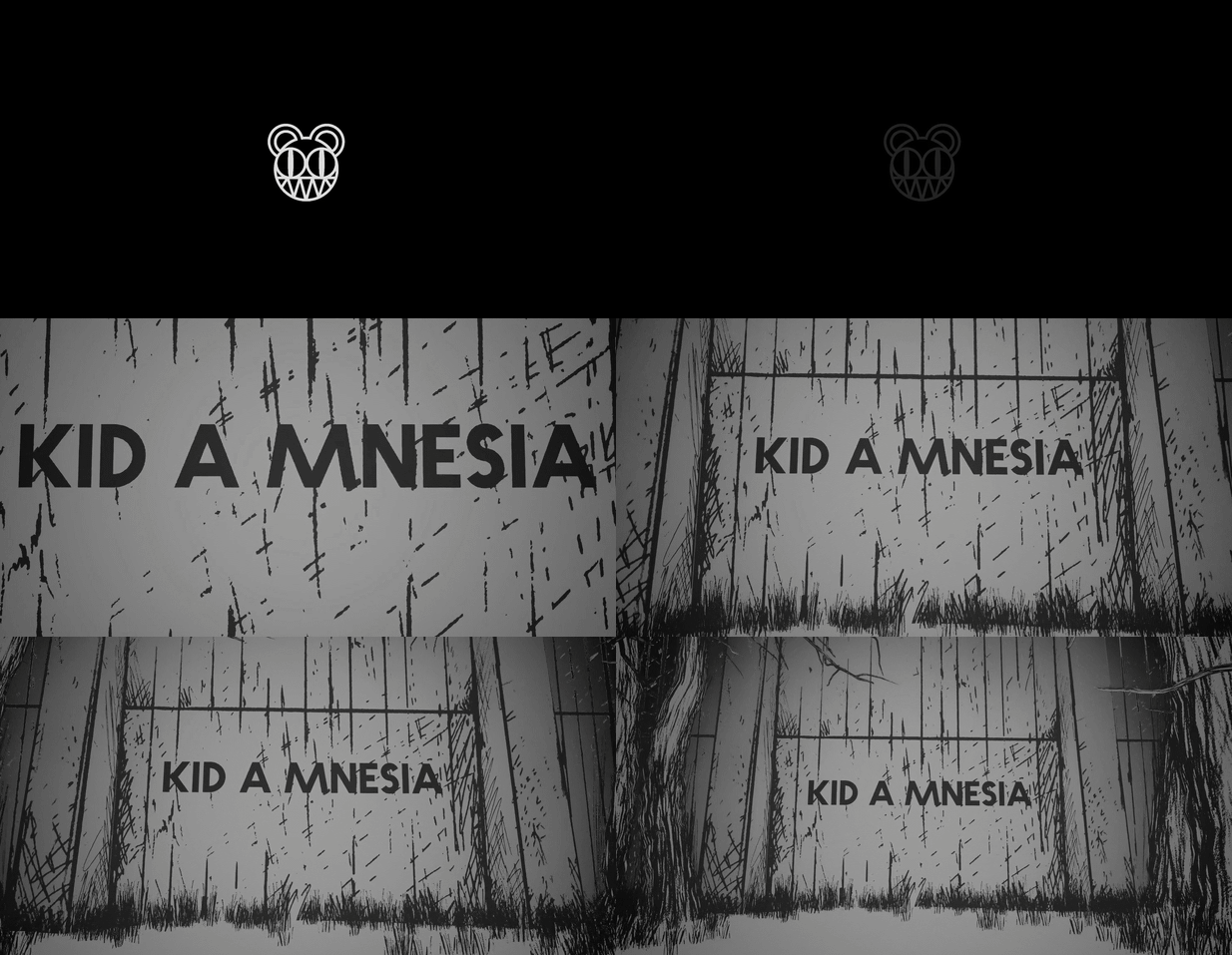
In November 2021, twenty-one years after Kid A was released, Radiohead put out Kid A Mnesia — a three-disc compilation that gathered both albums plus a third record, Kid Amnesiae, comprising previously unreleased material from the original sessions. The deluxe edition included an art book and a cassette of B-sides called Kid Amnesiette.
Yes, in the world of the PROFITABLE recorded music industry, this could look like a cash-grab anniversary package. This “yes, and” was also an archival act — and it was only possible because the original sessions had been documented with sufficient depth and discipline that two decades later there was still unreleased material worth presenting. Demos and rarities are the honey to a fervant fanbase. Kid Amnesiae is a third way of hearing the same creative moment, a different path through the same forest. The fact that it existed at all says something important: Radiohead and their collaborators treated the recording process itself as something worth preserving beyond the albums it produced. The archive wasn’t an afterthought. It was a resource.
For performing arts organizations, the parallel is not subtle. How many world premiere productions are documented in any form beyond a few photographs and a closing-night recording of dubious audio quality? How many design archives — the sketches, the models, the lighting plots, the dramaturgical notes — survive the strike? How many new works disappear not because they lack value but because no one thought to keep the material that would make a future remount, a touring production, or an anniversary revival actually possible?
The reissue was the setup. What happened next is the argument.
Kid A Mnesia Exhibition - 18 November 2021
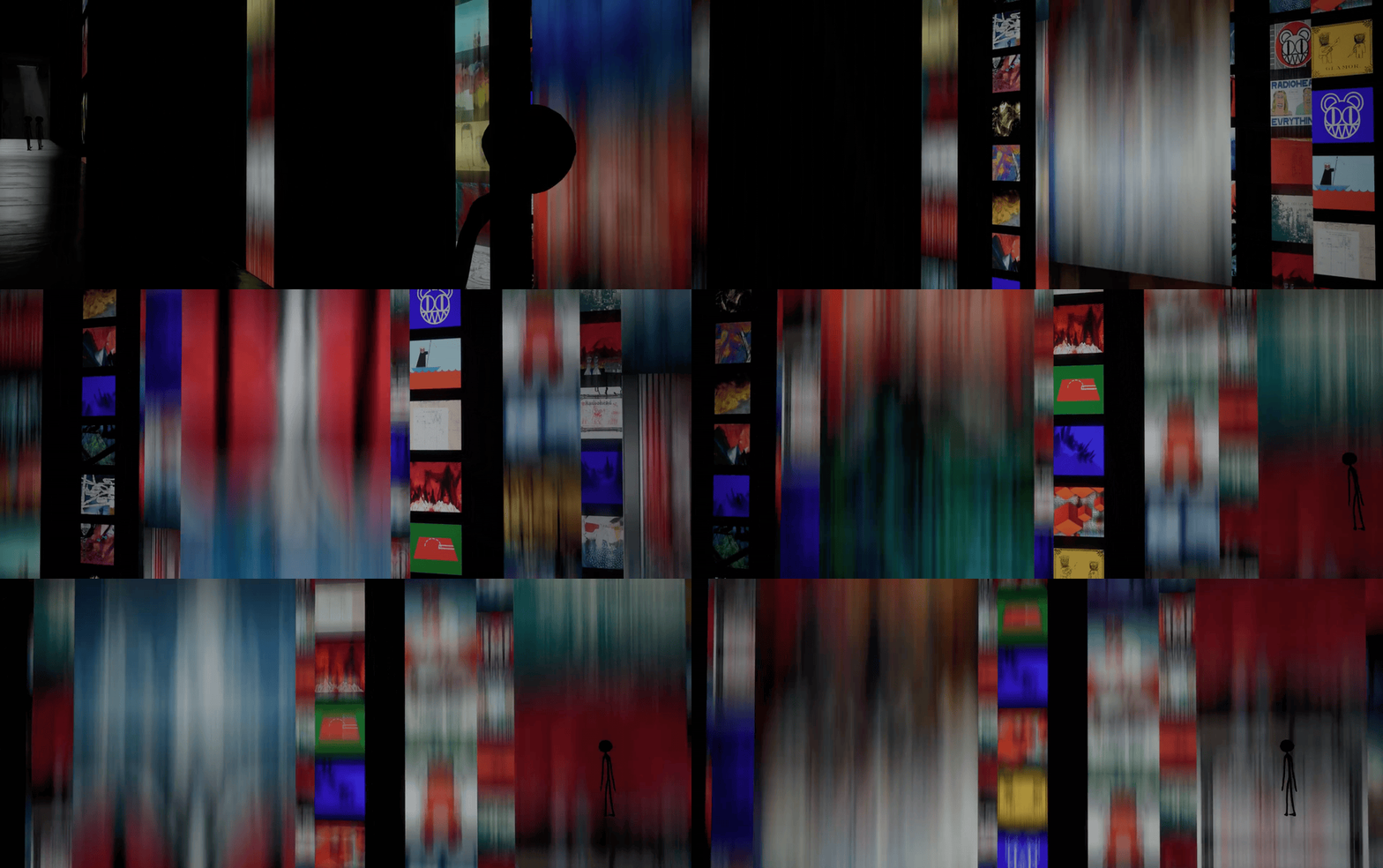
Kid A Mnesia Exhibition was originally conceived as a physical installation — a walk-through experience of the albums’ visual and sonic world. It was scheduled. It was designed. And then the COVID-19 pandemic made it impossible. The logistical problems were real and the timeline was gone.
Most arts organizations in 2020 faced a version of this. Productions canceled. Seasons gutted. The nearly universal response was to mourn what couldn’t happen and wait for conditions to return to normal. A smaller number pivoted to digital streaming of live performances — a medium that mostly exposed how unprepared the sector was to think cinematically about work designed for a room.
Radiohead’s team did something different. They took the visual and sonic materials of the planned physical installation and built a walking simulator in Unreal Engine — the game development platform that powers some of the most graphically sophisticated video games in the world. Developed by Namethemachine, Arbitrarily Good Productions, and Epic Games in collaboration with Yorke, Godrich, and Donwood, Kid A Mnesia Exhibition was released thirteen days after the Kid A Mnesia compilation — as a free download.
It had no enemies. No score. No levels. No way to die. Players moved through abstract virtual rooms, encountering artwork, listening to music, following no prescribed path. Jay Peters at The Verge called it “worth checking out as a very literal expression of the idea that video games can be art.” NME described it as “a deeply beautiful solo trip through what appears to be an apocalyptic wasteland, before little pockets of beauty show themselves in unexpected places, poking out of the darkness.” The New Yorker named it one of the best games of the year and wrote that it “provokes exploration, reflection, and a new way of listening.”
A new way of listening. To albums released in 2000 and 2001.
Like all of us, I yearned for anything that helped my cabin fever, especially approaching wintertime. I downloaded the Epic Games app and proceded through the game. It was a beautiful exploration, but I needed to be led. I’m not up for open world gaming and this was more that way than an objective-driven experience. It’s funny because it’s precisely the feeling I have when I go to a traditional museum.
The pandemic constraint did not diminish the work. It opened a medium the physical installation never could have reached. A walk-through installation in a gallery serves hundreds, perhaps thousands of visitors over a run. A free download on PlayStation 5 is available to anyone with a console and an internet connection, globally, indefinitely. The audience for the Kid A universe expanded in 2021 not despite the cancellation of the physical show but because of it — because the team had the creative flexibility, the archival depth, and the institutional relationships to make the turn.
That is the lesson that has almost nothing to do with technology and everything to do with producing philosophy. The question is not whether you can build a video game. The question is whether, when the plan fails — and in live performance, the plan always eventually fails — you have built the underlying work with enough richness and your collaborators with enough trust that transformation is possible rather than just loss.
Motion Picture House: Kid A Mnesia
The physical installation that COVID canceled finally opened at Coachella in April 2026. The collaborative work and the ACTUAL canvases of York & Donwood’s visual work. The walkthrough exhibit was an opportunity to experience scale or the work and the profound impact visual art can have while in the same room as it. That tactile energy is divine.


The music recording producer Nigel Godrich remixed the work in Spatial Audio, which experiencing the 75-minute film simultaneously on four screens in community with other New Yorkers was astounding. I was energized and received moments of emotional excitement and also tears of despair. I guess I am an extravert.
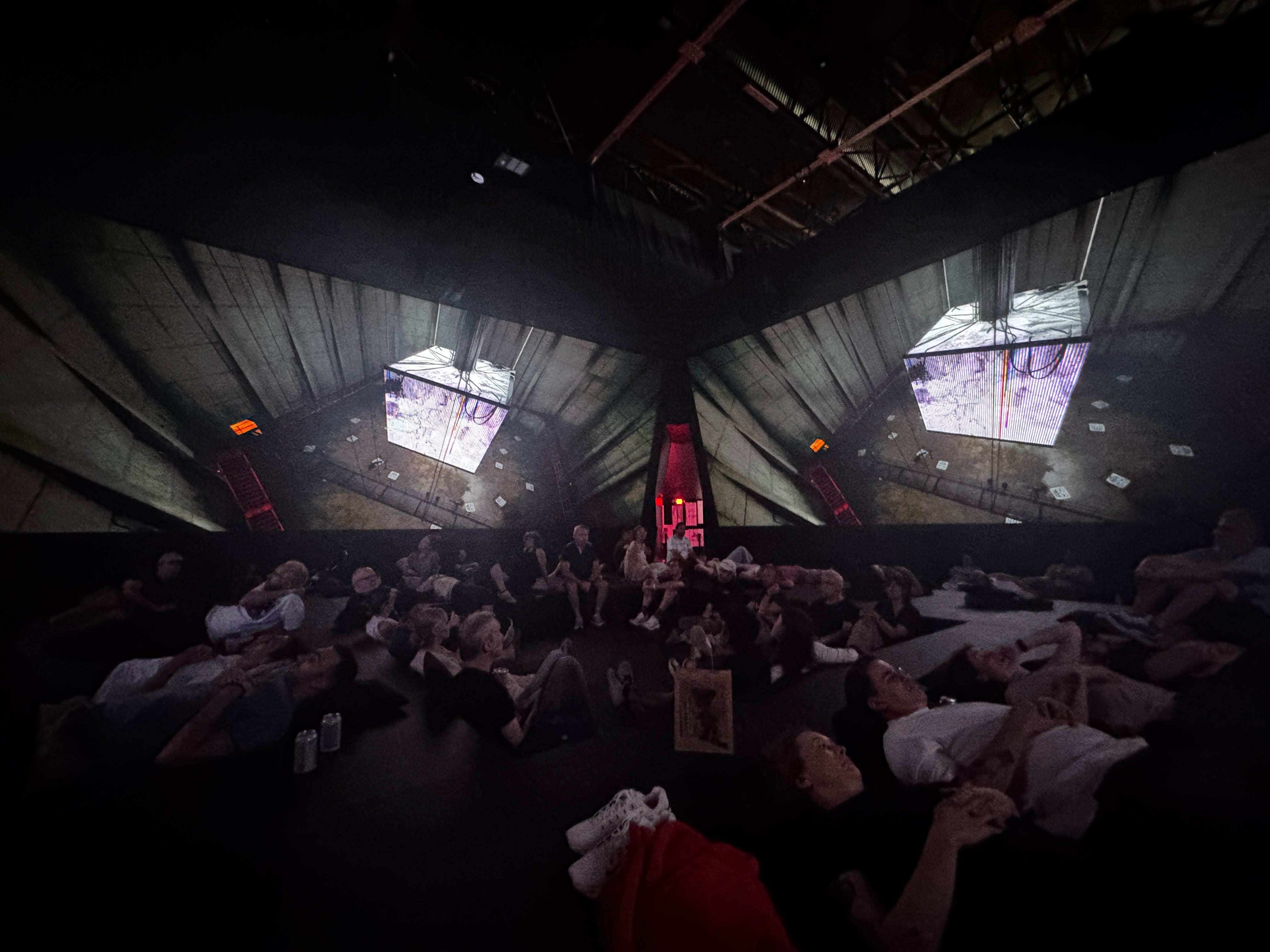
But it opened into a world where a significant new audience had already encountered the work digitally, had already developed a relationship with its visual language and spatial logic, and arrived at the bunker not as strangers but as returnees. The video game was not a substitute for the physical experience. It was the preview that made the physical experience land harder.
Five years of iteration, a pandemic in the middle, and the work came out the other side more present than it started.
The Five Roles on a Creative Timeline
(And Why Your Organization Needs to Know Which One It Occupies)
Here is where I want to get practical, because the Kid A Mnesia story offers something that is genuinely useful for anyone producing or commissioning or presenting creative work.
There are at least five distinct positions an organization can occupy on the timeline of a creative work:
Creator — The artist, the maker, the originating intelligence. In the performing arts, this is the composer, the librettist, the choreographer, the playwright, the author.
Commissioner — The entity that funds or enables the creation of original work, often in exchange for certain rights, windows of exclusivity, or producing credits. In opera, this is frequently the company that co-commissions a new work with three other organizations for a joint world premiere.
What they commissioned was a production. What was created was a work. These are not the same thing.
Producer — The organization that brings the work to audiences in a specific context, with specific resources, at a specific moment. A producer shapes the work through casting, design, budget, and interpretation. But the producer’s relationship to the underlying IP — the music, the libretto, the score — is almost always subordinate to the creator’s and often undefined past the initial production run.
Facilitator / Reissue Manager — The entity that manages subsequent iterations: the remount, the touring production, the cast recording, the archival presentation, the anniversary edition. In Radiohead’s world, this is whoever negotiated Kid A Mnesia, the 2021 compilation, and the deal that put the music inside a free downloadable video game published by Epic Games (more on this later.)
Presenter / Exhibitor — The organization at the end of the chain that puts the work in front of a live audience in a specific venue and market. The presenter typically has the least claim on the underlying IP and the most transactional relationship to the work: we are showing this here, on these dates, for this fee.
Most performing arts organizations do not stop to ask themselves which of these roles they are actually in, or what their agreements entitle them to as the work evolves over time. They negotiate a production license. They mount the show. They close the run. They move on.
And then, fifteen years later, the work becomes culturally significant, and someone else manages the revival, the film adaptation, the touring production, the immersive experience in a custom-built bunker — and the organization that developed it, nurtured it, took the artistic risk on it, has no structural claim to any of that future value.
This is not hypothetical. It is the operating reality of almost every new work development program in American performing arts.
The Programming Question: What If the Opera Were the Anchor?
There is a third dimension to this story that moves from IP strategy into something more immediate and more exciting for producing organizations: the question of programming as curatorial argument.
The Kid A Mnesia universe didn’t expand through sequels. It expanded through context. The video game was not a sequel to the albums. It was an entirely different medium for experiencing the same material. The physical installation is not a concert. It was a spatial encounter with sound and image that happened to use music you might already know.
This is a producing model that the performing arts can borrow without needing to be Radiohead. Consider what it would mean to treat an opera production not as an event but as an anchor for a broader curatorial argument.
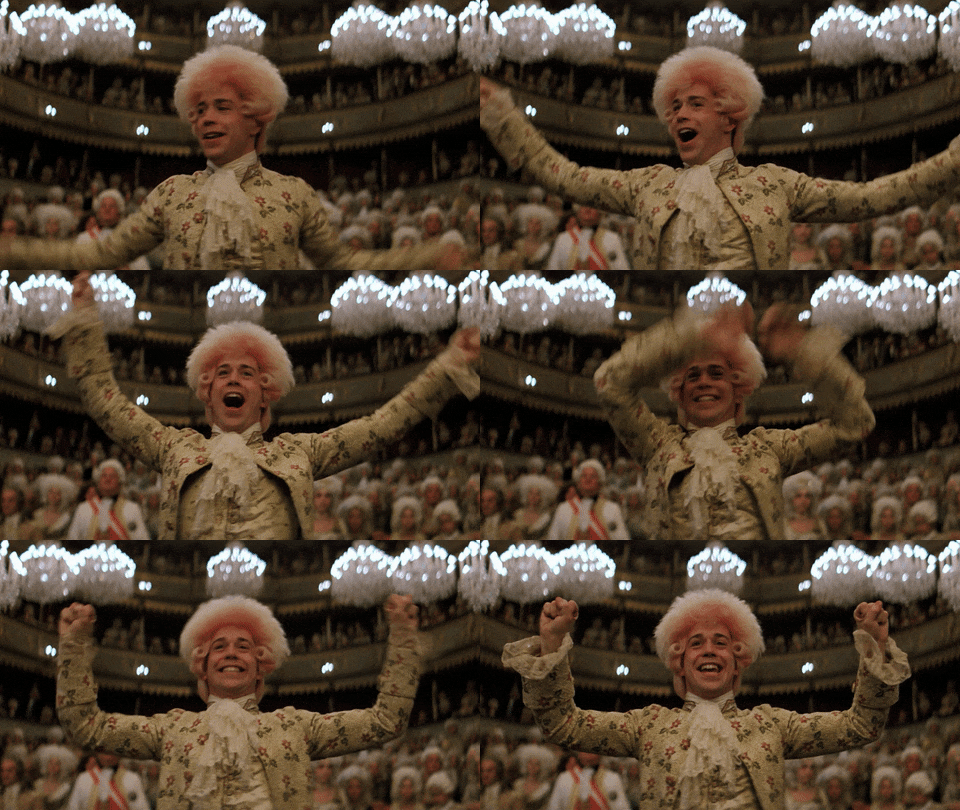
The Marriage of Figaro arrives. But the Marriage of Figaro doesn’t arrive alone. It arrives in the context of a screening of Milos Forman’s Amadeus at the local art cinema — the film that introduced an entire generation to Mozart’s world through the lens of jealousy and genius and the terrifying proximity of mediocrity to greatness. It arrives alongside Ragnar Kjartansson’s Bliss, the twelve-hour performance installation in which a single scene from the opera is sung on loop for the duration of a full day, until the boundaries between repetition and revelation dissolve entirely. It arrives preceded by a symposium, a commission, an installation, a film — all orbiting the same creative gravity.
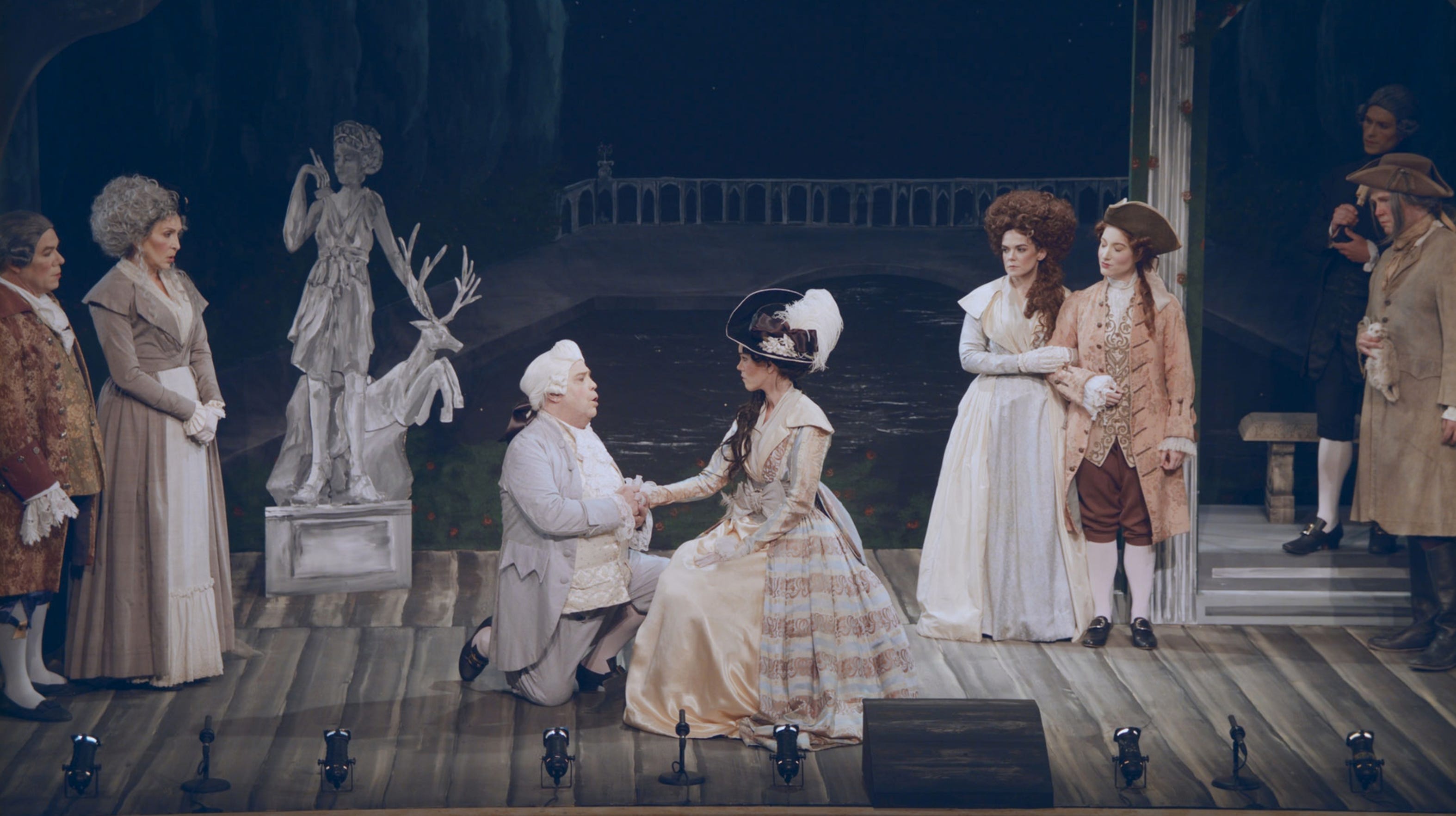
The opera is not diminished by this context. It is amplified by it. The audience that walks into the theater has been living in the world of the work for weeks. They are primed not for passive consumption but for genuine encounter.
This is curatorial programming rather than calendar programming. It requires longer planning horizons, more complex partnerships, and a different relationship between the producing organization and its community. But it generates something that a single-production calendar almost never can: the sense that what you are attending is part of something larger, that the evening matters beyond itself, that the organization programming it has a point of view and is willing to build a world around it.
Radiohead built that world over twenty-five years, largely without meaning to, because the work was rich enough to keep generating it. Organizations can build it deliberately, with intention, starting now.
What You’re Building When You Build a World
Let me close with the question your board probably isn’t asking.
The Kid A Mnesia story is instructive here not because Radiohead planned all of this — almost certainly they didn’t — but because the work was built with sufficient creative integrity and sufficient underlying richness that it kept generating possibilities. The question for producing organizations is not how to predict which work will have that generative power. You cannot know that in advance. The question is whether your agreements, at the point of creation, give you any meaningful role in what happens when the work proves to matter.
When the Motion Picture House: Kid A Mnesia bunker was built at Coachella, someone was credited as its producer. Someone negotiated the transfer agreements to Brooklyn, and Chicago, and Mexico City, and San Francisco. Someone manages the relationship between the original creative team — Yorke, Donwood, Godrich — and the presenting venues and the exhibition infrastructure. That someone has a role on the creative timeline. That role has value. That value was established, at least in part, by agreements made much earlier in the process, when the work was new and its future was unknowable.
The performing arts sector’s failure to think clearly about this is not a legal failure. It is a creative failure. It reflects an implicit assumption that new work is a product with a finite lifespan, that the production is the work, that what we are building closes on a Sunday night.
The Kid A Mnesia story suggests something different. It suggests that the production is the first sentence of a much longer story, and that the organizations and artists and collaborators who shape that first sentence — if they’ve been thoughtful about their agreements, if they’ve documented their process, if they’ve built the creative relationships to sustain future iteration — have the standing to keep telling it.
The voices are here. The infrastructure, in most cases, is not.
What would it mean to build it?