
HERE WE ARE, EXTERMINATING ANGELS
While opera is Olympic-level performance, it’s an exhibition, not a competition.

On the world’s stage, the 2026 Winter Olympics begin this week in Italy. The birthplace of “opera” (the word, which codified the meaning, “a great work”) is the destination for some of the greatest athletes in their chosen discipline to compete with each other for the best performance. After years of training, their mark on history will be whittled down to a moment riddled with factors that could hinder their best performance - weather considerations as well as performance space conditions, etc.
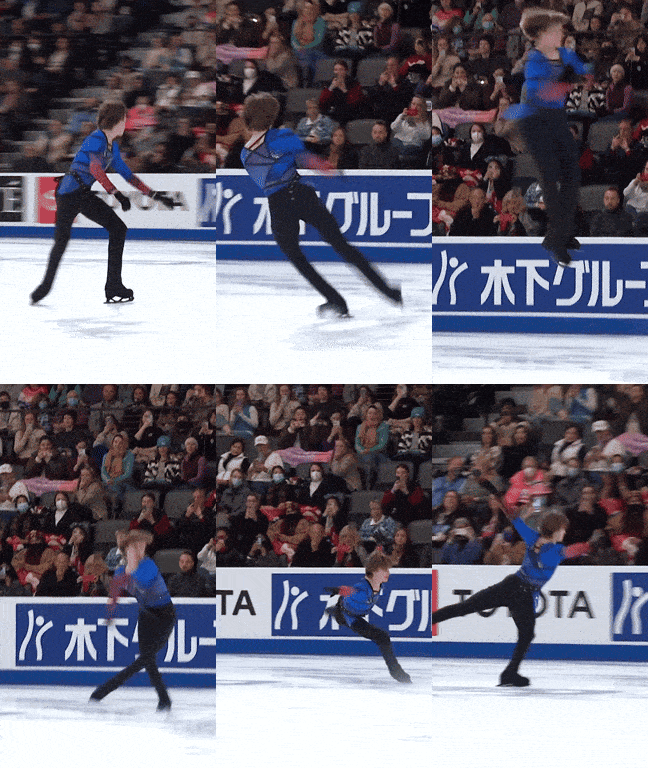
American figure skater Ilia Malinin is the only skater to have successfully landed the quadruple Axel, skating's most difficult jump, in competition. The two-time world champion became the first skater to land seven quadruple jumps in a single program at the 2025 Grand Prix Final this past December.
He’s talked about working on a quintuple jump, but won’t until after the Olympics, where he plans to make all 7 quads on the big stage. “It's pretty close,” he promised. “It's in the works. It's there, but after the Olympics that's when I want to give most of my attention to landing the quint for the public.”
Pushing the boundaries of what our bodies can accomplish is an endeavor documented throughout human history. In the case of figure skating, what happens in competition is not always what happens in exhibition. I guarantee Ilia Malinin would not do 7 quads while on tour for Stars on Ice or even Wozzeck on Ice.
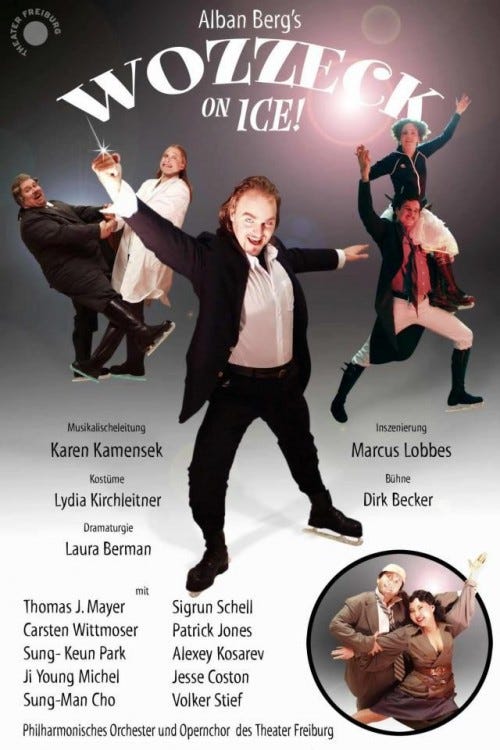
The same should be said for stage performances, especially in the context of opera, where we conventionally incorporate stage movement, and narrative action, words, as well as auditory performance.
While opera is an Olympic-level performance, it’s an exhibition, not a competition.
This is what producers and composers should keep in mind while developing new work. What is the intention behind the use of any mechanism for the public?
There’s a lot to consider, including the audience's threshold as well as the performer’s.
STORY vs MUSIC - an inverse proportion
If an audience is familiar with a story, then the composer can introduce or push a musical language.
This is how opera in Italy started. They used stories that everyone knew - historical or mythological - so adding the element of song was the factor the audience could focus on.
La bohème (whose operatic work is up to you) is based on Henri Murger’s La Vie de Bohème, which actually started as magazine sketches from 1845-1849. Murger’s stories became popular after they were first produced as a play in 1849. The interest in the play brought demand for the publication of the book in 1851. The two operas (yes, there are two) premiered decades later (1896 and 1897) after the book garnered international interest and translations. Amistad Maupin’s Tales of the City began the same way before the novels and then the telenovelas.
HERE WE ARE, EXTERMINATING ANGELS
Adaptations have long been a cornerstone of the performing arts, breathing new life into existing narratives by reimagining them through different mediums. Continuing this tradition, Luis Buñuel’s 1962 surrealist film El ángel exterminador (The Exterminating Angel) has inspired both an opera by Thomas Adès and a musical by Stephen Sondheim.


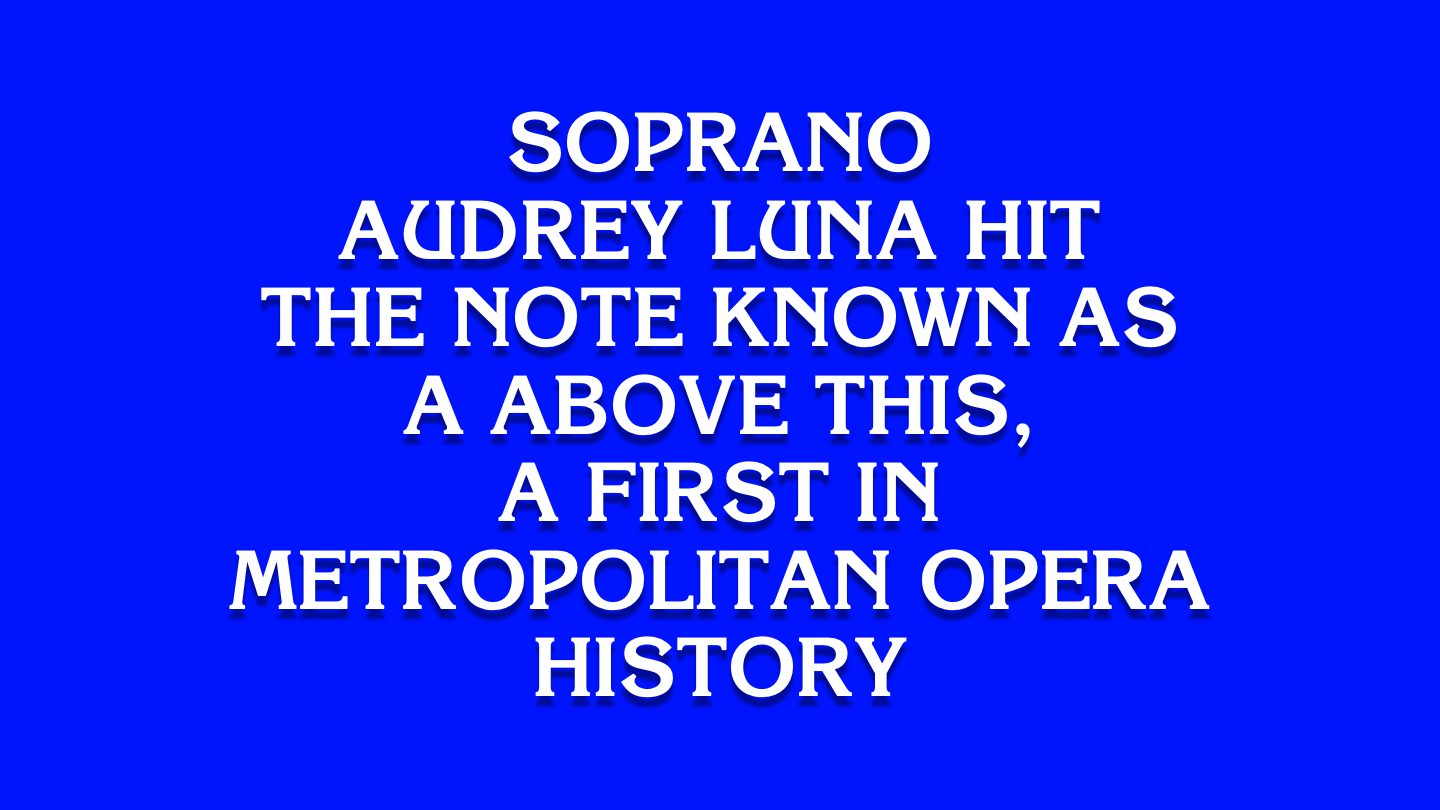
Thomas Adès' opera The Exterminating Angel premiered at the Salzburg Festival in 2016. Collaborating with librettist Tom Cairns, Adès translated Buñuel's tale of bourgeois guests inexplicably trapped after a dinner party into an operatic experience. The film itself has no score. The audience is trapped in the tension just as much as the characters on screen. Adès’ score is noted for its complexity and use of unconventional instruments, such as the ondes Martenot, to evoke the film's surreal atmosphere. Also, this is the opera where Jeopardy gets its answer (see above).
Stephen Sondheim's final musical, Here We Are, co-written with David Ives, draws inspiration from Buñuel's The Exterminating Angel and The Discreet Charm of the Bourgeoisie. Premiered in New York in 2023, the production satirizes the rituals of the upper class through a narrative split into two acts: a musical first half and a spoken-word second half.
WHEN WE LEAVE WHAT HAVE WE LEARNED
Two different composers, two different structures for stage work, two different aesthetics.
The reviews for both have quite the range. Adès’ opera is widely regarded as a significant, albeit challenging work. One headline reads, “If You See One Opera This Year, Make It ‘The Exterminating Angel’”, while another review states “Only the supertitles tell you that this is a dark comedy since the music is too heavy-handed to be humorous.”
For Here We Are, the Jesse Green from the New York Times mentions ,“Musically, it’s fully if a little skimpily Sondheim, and entirely worthy of his catalog.” And The Guardian dives in, “There is heartiness and humour but little of Sondheim’s usually intimate or penetrating psychology. Lyrics contain some good satire but also banal rhymes such as “Ladies and gents before we dine / Let us thank the lord for cheese and wine”. Recitative with deliberate dissonance seems strained at times.”
I was privileged to attend performances of both works and I understood more of the intention from Here We Are than The Exterminating Angel. With the conventional, “safe” landscape of the Sondheim, I was able to focus on the characters’ perspectives as well as their own study of moral substance. It was a digestible experience, where I could appreciate the humor in the surrealist situation(s). That is what I expected from the source material - even if there wasn’t a soundtrack to dictate our emotional response.
I was too uncomfortable in the sonic tension of Adès opera, that I couldn’t receive the commentary. The score and performances became a distraction. I was more concerned about what I was absorbing in real time, that I was too overwhelmed - the cacophonies (although I love the ones martinet), the lyrical comprehension, the phrasing. It was all too much and I shut down, unable to fully appreciate the complete work. I felt trapped and uncomfortable. However, that may have been the point - the opera audience is the bourgeois!
WHERE DO WE GO FROM HERE
Film studios spend millions on focus groups and market research to ensure the best outcome, sometimes to a fault. In the stage industry, we’re so thrilled with our accomplishment of getting the curtain to open, we let time be the arbiter of taste. Ten years later, The Exterminating Angel has continued to be produced in several productions, most recently at the Opera National de Paris.
I do hope Here We Are will have other productions.
All I’m sayin is just think about it…
ICE PRINCESS ON ICE
While Ilia Malinin will bring his 7 quads to the ice, Japanese skater Yuma Kagiyama will bring Christopher Tin's completion of Giacomo Puccini's unfinished opera Turandot.
From the YouTube description:
The collaboration between Yuma Kagiyama, his choreographer Lori Nichol, and Christopher Tin on this program has been much celebrated in the figure skating world since it was announced, with Lori and Carolina Kostner (Yuma's coach) attending the recording sessions in London, and then collaborating for months afterwards to refine the music for Yuma's routine. Christopher crafted a musical arrangement around Yuma's technical and timing demands for the routine, recording extra material to smooth transitions and match the accelerated pace of his routine. Meanwhile, with libretto in hand, Lori created choreography that channels the story of 'Turandot' into each of Yuma's movements.
NBC Sports commentator Mark Hanretty said, after Yuma's NHK Trophy win: "I defy anybody not to be moved by the emotion of the music, the story behind the creation of this piece, specially recorded for Yuma... ... it just has Olympic moment written all over this piece. I feel and sense it's set to be an iconic piece in the history of our sport to come."
'Turandot: Christopher Tin Finale' comes out February 6, 2026, and is performed by Christine Goerke (Turandot), Clay Hilley (Calàf), the English National Opera Chorus and Royal Philharmonic Orchestra, and recorded at Abbey Road Studios and conducted by Christopher Tin.
Set in legendary China, Puccini’s Turandot tells the story of an icy princess who vows never to marry, subjecting her suitors to a deadly challenge: solve three riddles or be executed. Prince Calàf falls in love with Turandot at first sight. Ignoring warnings, Calaf answers all three riddles correctly. However, Turandot, desperate to avoid marriage, refuses him. Seeking her love rather than submission, Calaf offers her a wager: if she can learn his name by dawn, she may execute him.
Puccini died in 1924, before he could resolve the plot with a credible way for Turandot and Calàf to fall in love by the end of the opera. In 2024, Washington National Opera commissioned and premiered a newly composed ending by librettist Susan Soon He Stanton and composer Christopher Tin, that sought to complete the opera in a more dramatically plausible manner.
I haven’t had a chance to read this yet but 12/10 for the header image.